

The Investment Case for Gold
Aug 26, 2026Every second, the United States government owes another $92,000. That is approximately $5.5 million a minute and $331 million an hour, running without pause whether markets are open or closed — and it is how the national debt came to cross $40 trillion this month.1 With numbers this large, it becomes easy to stop treating them as a bill that anyone actually pays. But it is paid, and the bill is rarely presented in a form that anyone recognizes. Alan Greenspan described deficit spending as a scheme for the “hidden confiscation of wealth,” and the operative word in that phrase is hidden. Debt on this scale is not repaid so much as it is diluted, and dilution is the rare portfolio risk that never appears as a loss on your statement; it simply takes a little off the top, year after year, until the number on the page and the life it buys have quietly parted ways. Gold’s claim for your attention begins here because it is the one asset that cannot be printed, legislated into existence, or expanded to suit a policy decision.
That distinction has practical value in a portfolio. Because gold’s drivers differ from those of equities and bonds, it diversifies for a reason rather than by coincidence. By participating when the economy is growing, gold has historically tended to hold its footing when equities are under pressure — precisely when diversification is worth paying for. Physical gold is no one’s liability. It does not depend on a counterparty’s solvency, a government’s good faith, or a promise being honored on the other side of the trade. And over long stretches of history, it has preserved purchasing power that paper currency has not. While gold has historically moved over long, large cycles, during specific periods when equities perform exceptionally well, gold has a tendency to underperform.
Good as Gold: A Note on Portfolio Positioning
No homeowner buys insurance hoping to use it. The premium is paid year after year, and if the house never burns down, the money is gladly gone. Gold has often been viewed in much the same way: portfolio protection against monetary mischief, but one that can feel costly while investors wait for a crisis that may never arrive.
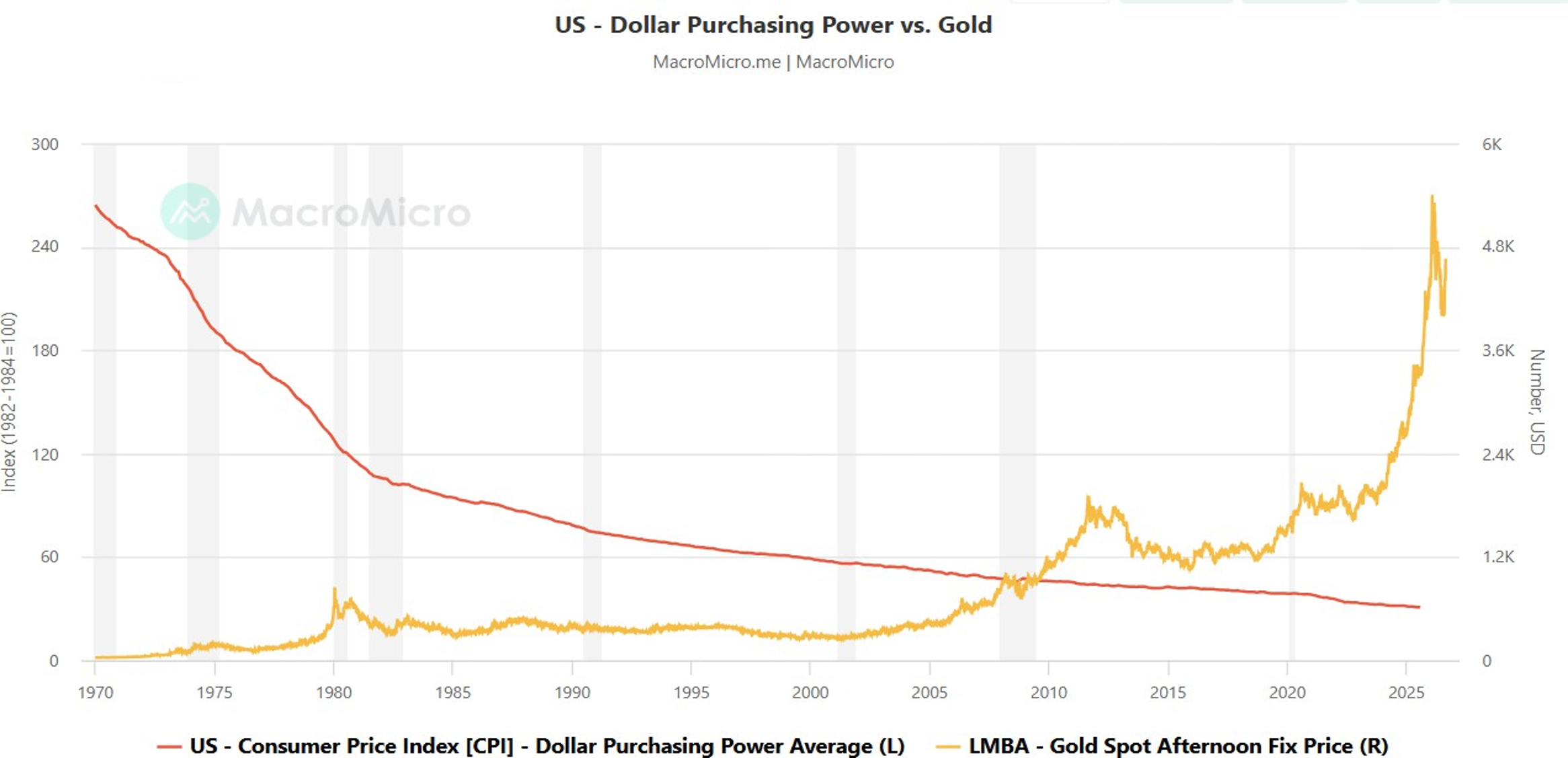
Every so often, however, the environment changes enough that the insurance policy itself becomes one of the better-performing assets in a portfolio. We believe this is one of those periods. Gold recently traded near $4,500 per troy ounce, up roughly 36% from a year ago.2 In our view, four structural forces continue to support the case for a measured allocation: a constrained Federal Reserve (the Fed), weakening confidence in the U.S. dollar, the use of the U.S. dollar as a geopolitical tool, and a national debt over $40 trillion.
A Central Bank Between a Rock and a Hard Place
On July 29, 2026, the Fed left the federal funds rate unchanged at 3.50%–3.75% for a fifth consecutive meeting, even as consumer prices rose 3.5% year over year in June —above the Fed’s 2% target.3 In a more typical cycle, inflation this persistent would invite additional tightening. We contend that this is not a typical cycle.
With federal interest costs rising alongside the national debt and the labor market softening, the Fed appears reluctant to raise rates further. That leaves the real, inflation-adjusted policy rate near zero. This matters for gold because the metal’s historical weakness is opportunity cost: gold pays no coupon, so its appeal tends to rise when cash loses purchasing power and real yields offer little compensation. In simpler terms, gold maintains its purchasing power while the dollar deteriorates in value.
As precedent for this pattern, in the 1970s, the Fed repeatedly hesitated to tighten into a weakening economy, and gold rose from $35 per ounce in 1971 to $850 by January 1980 when the dollar’s final link to gold was severed.4 We are not forecasting a repeat of that magnitude. However, the narrower lesson is that when policymakers are unwilling or unable to restrain inflation, gold can become a market-based check on paper currency.
The World Is Voting With Its Vaults
Foreign confidence in the dollar is not merely weakening in theory; it is visible in the data. Global central banks purchased a net of 863 tonnes of gold in 2025.5 Over the same period, the dollar’s share of global foreign exchange reserves declined from about 71% in 2001 to 57% today.6 The dollar reflected similar pressure, with the U.S. Dollar Index falling 10.7% in the first half of 2025, its steepest first-half decline since 1973.7
We do not believe a dollar collapse is the base case. But a long, measured decline does not require a crisis. For a dollar-based investor, gold is one of the few assets that can benefit mechanically as the dollar weakens. Reserve managers are already increasing their gold exposure, and the MAP Investment Team sees little reason for investors to ignore that signal.
The U.S. Dollar: A Geopolitical Tool
The United States’ willingness to use its reserve-currency status as a geopolitical tool strengthens the strategic case for gold. Sanctions on Russia, continued restrictions on Iran, and until recently, Venezuela have shown that dollar reserves are not purely financial assets; they can become instruments of foreign policy. For countries whose geopolitical interests may diverge from Washington’s, this creates a vulnerability: reserves held in dollars can be frozen, restricted, or rendered less useful if the United States decides to apply pressure. In an increasingly bipolar world shaped by competing superpowers, that risk gives foreign reserve managers a clear incentive to diversify away from the dollar and toward assets outside any single country’s control. Gold fits that role because it is no one’s liability, cannot be sanctioned by an issuing government, and serves as a neutral reserve asset in a fragmented geopolitical environment.
If Washington extends sanctions beyond Iran to include countries that continue doing business with Tehran, access to the dollar system becomes even more conditional. Secondary sanctions would broaden the perceived risk from U.S. adversaries to any nation maintaining commercial relationships Washington opposes. That matters for gold. The more widely dollar access can be restricted, the more attractive it becomes for sovereign reserve managers to hold an asset that does not rely on U.S.-controlled payment rails, correspondent banks, or the legal reach of American sanctions policy. Gold would not eliminate the economic cost of sanctions, but it can reduce dependence on the infrastructure used to enforce them. Broader secondary sanctions could therefore accelerate reserve diversification and reinforce gold’s role as a politically neutral store of value in a world where financial networks are increasingly used as instruments of control.
Forty Trillion Reasons
As mentioned, public debt outstanding exceeds $40 trillion, and neither political party has advanced a credible plan to slow its growth. The debt burden connects directly to our earlier points: it raises the fiscal cost of higher interest rates, which can deepen the Fed’s reluctance to tighten, and it influences foreign reserve managers who are shifting part of their exposure from Treasuries toward gold bullion.
Every fiat currency is ultimately managed for the convenience of its issuer. Gold sits outside that system. It is no one’s liability, cannot be created by a keystroke, and grows only as fast as it can be mined.
So Why Not Purchase Gold Mining Equities?
We are occasionally asked why we prefer direct investment to gold through the purchase of exchange traded vehicles backed by physical bullion. We utilize the Sprott Physical Gold and Silver Trust and SPDR Gold MiniShares Trust as they offer a convenient way to gain exposure to gold without owning physical bullion. We do not completely rule out gold mining equities and have purchased them in the past. However, we believe gold mining equities have a different risk profile than the metal itself for several reasons:
- Geopolitical Risk: Deposits and mines can be exposed at any time to seizure, shifting regulations, or higher tax burdens when metals prices
- Operational Risk: Mining businesses face labor, environmental, input-cost, and accident Deep underground mines, such as those in South Africa, can carry especially high costs and hazards.
- Counterparty Risk: Physical gold has limited counterparty risk, while mining equities add exposure to business execution, management decisions, and balance-sheet stress that can impair returns even when the price of gold is rising.
- Portfolio Role: We view miner exposure as a more speculative equity position, which can add risk to an asset intended to serve as portfolio
- Leverage Cuts Both Ways: The same operating leverage that can drive outperformance in rising markets can also magnify underperformance in flat or declining markets.
MAP’s Positioning
The Investment Team believes a measured, strategic allocation to gold has earned a place in the current environment — not as a bet on catastrophe, but as a ballast. Gold can serve as a diversifying store of value alongside the durable, cash-generating businesses that remain the core of our portfolios.
Investors should consider that gold: can be volatile, it produces no income, is expensive to store and insure, can face disadvantageous tax treatment, and is subject to potential government confiscation in some countries. And because gold does not have an income component, it tends to underperform in an environment when real yields rise. Therefore, positions should be sized accordingly, depending on risk tolerance and investment timeline. After a 36% twelve-month advance, investors should expect drawdowns along the way, and one year’s move should not be projected forward. Still, the conditions supporting the insurance policy — a constrained Fed, a softer dollar, and a debt clock that continues to move in one direction — appear structural rather than fleeting. For once, the premium is paying investors.
Our objective remains to invest responsibly over time through thoughtful security selection, prudent risk management, and consistent discipline, while remaining mindful of the risks inherent in every investment decision.
We encourage you to contact your MAP representative with any questions or concerns.
Managed Asset Portfolios Investment Team
Michael Dzialo, Karen Culver, Peter Swan, Zachary Fellows, and Nicolas Vilotti
August 2026
1https://fiscaldata.treasury.gov/datasets/debt-to-the-penny/debt-to-the-penny
2Bloomberg L.P. Spot Gold $/Oz as of 8/19/2026
3Federal funds target range (3.50%–3.75%, held at the 7/29/2026 FOMC meeting, fifth consecutive hold) and June 2026 CPI (+3.5% year-over-year, U.S. Bureau of Labor Statistics): via Trading Economics, tradingeconomics.com/united-states/interest-rate.
4Historical gold prices: Bloomberg L.P. Spot Gold $/Oz
5https://www.gold.org/goldhub/research/gold-demand-trends/gold-demand-trends-full-year-2025/central-banks#from-login=1&just-verified=1. Central bank gold purchases (1,092t in 2024; 1,037t in 2023; 1,136t in 2022).
6https://data.imf.org/en/news/imf%20data%20brief%20march%2027
7Bloomberg L.P. DXY Index
Certain statements made by us may be forward-looking statements and projections which describe our strategies, goals, outlook, expectations, or projections. These statements are only predictions and involve known and unknown risks, uncertainties, and other factors that may cause actual results to differ materially from those expressed or implied by such forward-looking statements. The information contained herein represents our views as of the aforementioned date and does not represent a recommendation by us to buy or sell this security or any other financial instrument associated with it. Managed Asset Portfolios, our clients and our employees may buy, sell, or hold any or all of the securities mentioned. We are not obligated to provide an update if any of the figures or views presented change.

