

Protecting the Lead: The MAP Global Balanced Strategy and the Inherited IRA
Oct 20, 2026Every baseball fan knows the closer has the strangest job on the roster. They are not asked to hit home runs, and they are rarely asked to pitch more than one inning. Their entire purpose is to take a lead that someone else built and carry it safely across the finish line. When the home team brings in their closer in the ninth inning, no one in the stands is hoping for fireworks. They are hoping for three quiet outs. In most cases, an inherited Individual Retirement Account (IRA) asks the beneficiary to play precisely that role, and for many, the MAP Global Balanced strategy is built to carry that lead to the end of the game.
A Different Kind of Retirement Account
An inherited IRA is an account the original owner spent decades building. Under current law, most non-spouse beneficiaries must empty the account within ten years of the original owner's death, and in some cases must take required minimum distributions (RMDs) along the way. Every dollar withdrawn from a traditional inherited IRA is taxed as ordinary income, and no new contributions can be made. Together, those constraints fundamentally change the investment problem. The time horizon becomes fixed and short, the withdrawals become mandatory rather than discretionary, and a loss in the early years cannot be replenished with fresh capital or by simply waiting it out. In most cases, the beneficiary's job is to protect the lead while drawing it down on a schedule set by the Internal Revenue Service, not by the beneficiary’s own time horizon.
This is where the familiar advice to "stay invested for the long run" breaks down. A thirty-year-old who is contributing to a Roth IRA can weather a 30% drawdown because time and future contributions can help rebuild the account. The beneficiary of an inherited IRA has no such luxury. The account does not need to be drawn down in equal installments, but it does need to be emptied, and taxed, by the end of year ten, which means every investment will be sold and distributed on a schedule the market does not care about. A sharp decline in year two leaves fewer years for the account to recover before that deadline arrives, and a decline in year nine leaves very little time. Academics call this sequence-of-returns risk, and that risk is amplified if the beneficiary is taking RMDs in the process. For this reason, downside protection matters more than headline returns in an inherited IRA.
Three Quiet Outs: What the Rolling Returns Reveal
We have long believed that the most honest way to evaluate a balanced strategy is by what it does across every three-year period an investor might have actually experienced. The table on the following page, drawn from the June 30, 2026 Fact Sheet, examines 264 rolling 36-month periods for our MAP Global Balanced Composite since July 31, 2004, a span that includes the Great Financial Crisis, the 2020 pandemic collapse, and the 2022 bond and equity selloff.
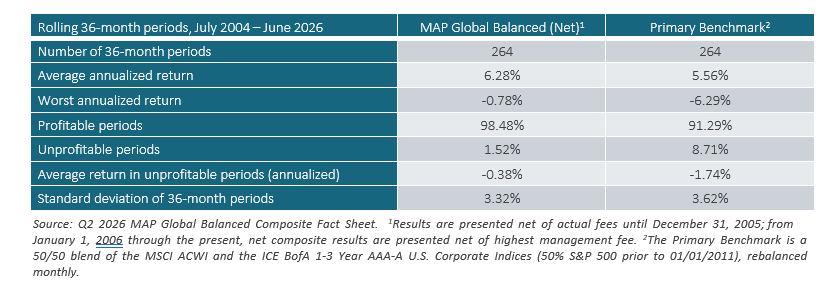
We believe two numbers in the table deserve full attention. First, the worst three-year stretch an investor in the strategy has experienced was an annualized loss of 0.78%, compared to the Primary Benchmark’s loss of 6.29% for the same period. Second, 98.48% of all rolling three-year periods were profitable, and only 1.52% of all rolling three-year periods were unprofitable. Put plainly, over a span that included two of the worst stock market shocks of the past century, investors in the MAP Global Balanced Composite for any three-year window from July 31, 2001 through June 30, 2026 ended that window very close to, or above, where they started on average. For the beneficiary who may be forced to sell in any given year, we believe consistency of returns and downside protection is more appropriate in this scenario than chasing upside with the potential for more volatility.
The capture ratios tell a similar story from a different perspective. Since inception, the MAP Global Balanced Composite has participated in 99.18% of the Primary Benchmark's upside months while absorbing only 81.18% of the Primary Benchmark’s downside months, with a Beta of 0.831 and a Sortino ratio of 1.521. This was not achieved by hiding in cash. The composite has been roughly 50-60% invested in equities. We have managed money historically by owning temporarily out-of-favor businesses with a margin of safety, pairing them with a short-duration bond portfolio, and refusing to chase whatever is fashionable. Capital that is not lost never needs to be recovered.
Income to Meet the Schedule
Downside protection solves half of the inherited IRA problem. The other half is funding mandatory withdrawals without being forced to sell equities to pay taxes at the wrong moment. In the case of the MAP Global Balanced Composite, the strategy's structure does the work. As of June 30, 2026, the composite’s fixed income allocation was roughly 39%, carrying a yield-to-maturity of 4.98% with a duration of just over 2 years. This means it has low sensitivity to interest rate swings and returns principal quickly. Combined with an above-average dividend yield on the equity sleeve and the occasional use of covered calls, the portfolio generates current income that can satisfy a portion of a typical annual distribution. The beneficiary can sell less, sell later, and sell on their own terms.
MAP’s Positioning
A ten-year clock, taxable forced distributions, and little ability to replenish losses argue for a strategy that has historically kept its worst three-year outcomes near zero, captured most of the market's gains, and paid its investors to wait. That is what the MAP Global Balanced strategy has experienced, and it is what we intend to keep providing. While we recognize that each investor is unique with differing objectives and investment constraints, for those investors who are further in their financial lifecycle, the MAP Global Balanced strategy can provide the drawdown protection and steadiness essential for an account that must be emptied on a fixed timeframe.
To our long-standing clients, thank you for your continued trust; to those evaluating us for the first time, we welcome the conversation.
We encourage you to contact your MAP representative with any questions or concerns.
Managed Asset Portfolios Investment Team
Michael Dzialo, Karen Culver, Peter Swan, Zachary Fellows, CFA, and Nicolas Vilotti
October 2026
1Source Data: As calculated by Zephyr® using Monthly Net Returns as of 06/30/2026. Zephyr uses the ICE BofA U.S. 3-Month Treasury Bill Index as the risk-free rate for the applicable risk statistic calculations. Statistical performance data has been obtained from sources deemed reliable but are in no way guaranteed by us as to their accuracy.
Certain statements made by us may be forward-looking statements and projections which describe our strategies, goals, outlook, expectations, or projections. These statements are only predictions and involve known and unknown risks, uncertainties, and other factors that may cause actual results to differ materially from those expressed or implied by such forward-looking statements. The information contained herein represents our views as of the aforementioned date and does not represent a recommendation by us to buy or sell this security or any other financial instrument associated with it. Anthropic (2026) Claude assisted in the drafting of this piece using MAP Global Balanced Composite data. Managed Asset Portfolios, our clients and our employees may buy, sell, or hold any or all of the securities mentioned. We are not obligated to provide an update if any of the figures or views presented change.
Investment advisory fees are described in MAP’s Form ADV, Part 2A, Item 5. Past performance is no guarantee of future results. There is no guarantee that any investment will achieve its objectives, generate profits, or avoid losses. Managed Asset Portfolios, LLC claims compliance with the Global Investment Performance Standards (GIPS®). To obtain a GIPS Report and/or policies for valuing investments, calculating performance, and preparing GIPS Reports visit our website at: https://www.managedassetportfolios.com/due-diligence-documents or call us directly at (248) 601-6677.
Tax and distribution rules for inherited IRAs depend on the beneficiary's relationship to the original owner and other factors. This piece does not constitute tax or legal advice. You should consult your tax advisor regarding your specific situation.

