

Portfolio Construction
May 11, 2026Since its founding in late 2000, MAP has remained focused on delivering superior risk-adjusted returns while providing exceptional client service. Over the years, MAP has been recognized by third-party investment databases such as Informa Financial Intelligence’s PSN and Lipper’s Broadridge for its outstanding historical risk-adjusted returns. Of course, past performance does not guarantee future results, but MAP’s investment strategies tend to outperform their benchmarks when markets are down, flat, or modestly higher. Conversely, performance tends to rise less than the benchmark during risk-on environments, trailing their benchmarks when markets throw caution to the wind.
We often liken portfolio construction to a cross-country flight. Investors can choose between a Dreamliner and a puddle jumper. Both will reach the destination, and both will encounter turbulence along the way, but the Dreamliner delivers a markedly smoother and more comfortable journey. While turbulence is impossible to eliminate entirely, MAP’s Investment Team seeks to construct portfolios designed to provide that Dreamliner experience for our clients. This matters because excessive downside volatility often leads investors to sell at the most inopportune times. Staying invested, rather than attempting to time outcomes, is critical. Our well-constructed portfolios are designed for less downside volatility and are more likely to provide investors with confidence and comfort to remain invested in the market.
In this Thought Piece, we focus on portfolio construction and why it has played a key role in delivering strong risk-adjusted returns over the past quarter-century. Individual security selection may drive returns in any given period, but it is construction—how positions are sized, correlated, funded, held, trimmed, and exited—that determines whether those returns are durable and repeatable.
Conviction
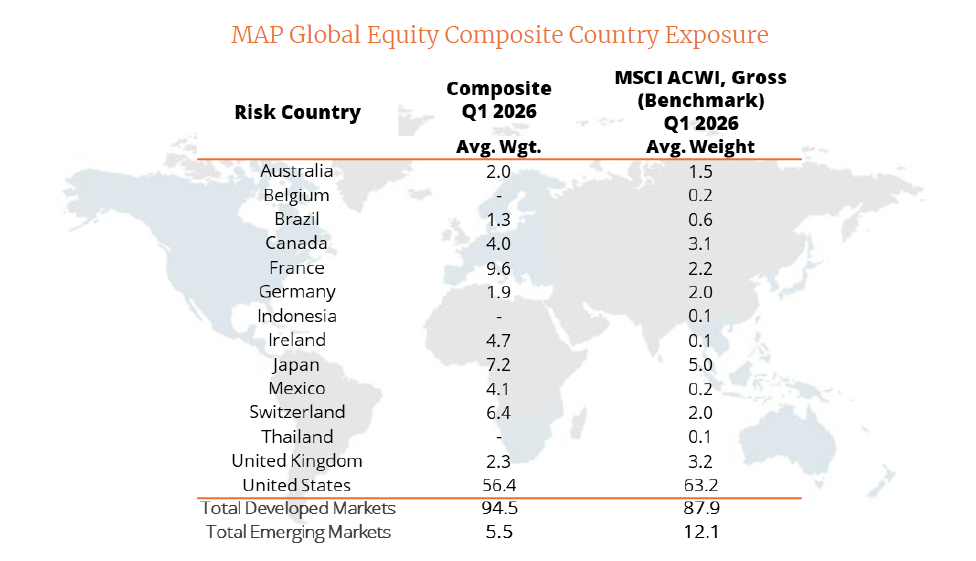
At MAP, we are not opposed to being significantly overweight in sectors or geographies where we have the highest conviction, or significantly underweight—or entirely absent—from those in which we have no conviction. For example, we currently overweight Mexico and Latin America in our global strategies because we find valuations attractive and those markets tend to outperform as the dollar falls. We do not own China, as its lack of transparency outweighs otherwise attractive valuations. We are also overweight Western Europe. Again, we believe valuations and dividend yields are attractive relative to the U.S., and we believe the geopolitical environment will force the region to ramp up fiscal spending, which should be stimulative for their economies.
A portfolio that cannot be rebalanced during times of pressure is not a portfolio; it is merely a collection of hopes and dreams. As such, we stress liquidity as much as valuation. Position sizes are calibrated under realistic exit assumptions, even during stressed conditions. This can result in more conservative sizing for less liquid securities than their apparent mispricing would otherwise justify, though not every position in a less liquid name is necessarily small.
Correlation: A Hidden Risk
When holdings are highly correlated, they often rise and fall together—meaning a portfolio can carry more hidden risk than it appears, particularly during periods of market stress when correlations tend to rise. By pairing positions with different drivers of return and avoiding unintended concentration, we seek to build portfolios where diversification is real, drawdowns are more manageable, and rebalancing can add value over time.
Asymmetry vs. Diversification
‘Diworsification,’ a word coined by Peter Lynch in the late 1980s, refers to over-diversifying a portfolio, where adding more investments increases complexity and costs without reducing risk or improving returns. Traditional diversification often becomes ‘diworsification’ when a long tail of low-conviction holdings neither protects capital nor meaningfully contributes to returns. As a high conviction manager, we begin with asymmetry. Each position must offer a skewed payoff— whereby the potential upside significantly outweighs the downside risk.
High conviction alone does not justify size. We explicitly separate “confidence in the thesis” from “confidence in downside containment.” The largest positions are reserved for situations where both are high: where business quality is durable, the balance sheet is resilient, and valuation embeds a robust margin of safety under multiple scenarios.
Many “active” managers are little more than “closet indexers.” Such managers are slightly overweight sectors or geographies they like, while slightly underweight those they do not. By employing this strategy, their results rarely stray far from their benchmarks. After factoring in management fees, many active managers underperform their benchmarks.
Identify A Catalyst
The edge of a long-term investor is not simply patience; it is the ability to remain invested during periods when the market disagrees. Patience should be paired with a timeline for thesis realization. We insist that each holding has a catalyst to unlock value. Too many investors fall into the familiar “value trap,” whereby a stock that is cheap today remains cheap for years. A catalyst may take the form of a new management team, a product cycle, corporate restructuring (divestitures, acquisitions, buybacks), industry consolidation, or shareholder activism.
Develop Global Themes
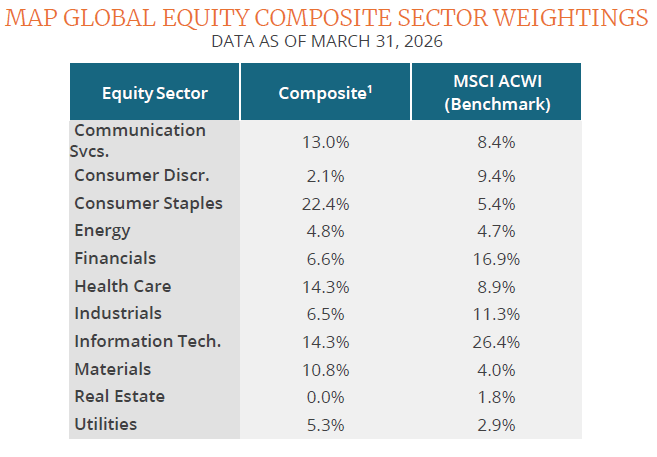
While our process begins with bottom-up, value-oriented stock selection, individual ideas never exist in isolation. Every investment must earn its place within a clearly defined global theme. This thematic discipline is a defining feature of our approach and a key point of differentiation from traditional value managers. Experience has taught us that disciplined omission is as important as selective inclusion—what we choose not to own often protects capital as much as what we do. These enduring themes directly inform sector allocation by guiding where capital is concentrated, where exposure is limited, and where entire sectors are deliberately excluded when they conflict with our long-term convictions. Our global thematic filters have helped us sidestep many of the market’s most damaging drawdowns. Because we invest with patience and a long-term horizon, the themes guiding our portfolios are designed to endure, evolving precisely rather than reacting to short-term market noise.

Created by ChatGPT
A high conviction value portfolio succeeds not by eliminating uncertainty, but by structuring exposure so that uncertainty works in its favor over time. In its 25-year history, MAP’s successful value investing did not result from always being correct; it came from being wrong in survivable ways and correct in ways that actually matter. MAP has navigated extraordinary market cycles and crises, including the bursting of the dot-com bubble, the Great Financial Crisis, a sovereign debt crisis, a global pandemic, and now a world adapting to higher inflation and significant geopolitical complexity. In each instance, sticking to our systematic process—avoiding overvalued assets, patiently holding high-quality businesses, and selectively adding to positions during periods of irrational fear—has helped our portfolios preserve capital during downturns and compound returns effectively. While our approach may, at times, appear out of step with short-term market enthusiasm, our long-term results speak to the power of patience and discipline.
If you have any questions about our strategies, please contact your MAP representative.
Managed Asset Portfolios Investment Team
Michael Dzialo, Karen Culver, Peter Swan, Zachary Fellows, and Nicolas Vilotti
May 2026
1The information provided is supplemental and complements the MAP Global Equity Composite GIPS® Report and quarterly Fact Sheet. Descriptive statistics derived from holdings based on the aggregate of individual client portfolios in the Composite. Holdings of individual client portfolios in the Composite may differ, sometimes significantly, from those shown. This information does not constitute, and should not be construed as, investment advice or recommendations with respect to the securities listed.
Certain statements made by us may be forward-looking statements and projections which describe our strategies, goals, outlook, expectations, or projections. These statements are only predictions and involve known and unknown risks, uncertainties, and other factors that may cause actual results to differ materially from those expressed or implied by such forward-looking statements. The information contained herein represents our views as of the aforementioned date and does not represent a recommendation by us to buy or sell this security or any other financial instrument associated with it. Managed Asset Portfolios, our clients and our employees may buy, sell, or hold any or all of the securities mentioned. We are not obligated to provide an update if any of the figures or views presented change.
MSCI data contained herein or delivered in connection with this notice (collectively, the “Information”) are copyrighted, trade secrets (when not publicly available), trademarks and proprietary property of MSCI Inc. or its subsidiaries (collectively, “MSCI”), MSCI’s licensors, direct or indirect suppliers and authorized sources, and/or any third party contributing to the Information (collectively, with MSCI, the “Information Providers”).

