

MAP Views Fourth Quarter 2026
Oct 01, 2026The third quarter of 2026 was driven by three primary themes: solid corporate earnings, resilient stock markets, and rising interest rates.
Second quarter headline S&P 500 earnings grew 51% year-over-year, one of the strongest results on record outside of rebound periods following events such as the COVID-19 pandemic or the Global Financial Crisis (GFC).1 Growth was led by technology, supported by the Artificial Intelligence (AI) buildout, and energy (which benefited from higher prices stemming from the war with Iran), as well as mark-to-market investment gains. Excluding the latter, growth was still strong at approximately 30%.
AI-related capital spending continued to drive both corporate earnings and the broader economy, accounting for nearly 2% of GDP. The last time U.S. capital expenditures reached a comparable share of GDP was during the railroad expansion of the mid-1800s, whereby aggregate productivity and U.S. GDP in 1890 would have been approximately 25% lower if the railroad network had never been built.2
As the quarter ended, several prominent AI leaders—including the CEOs of OpenAI and Anthropic, as well as Elon Musk—called for slowing the AI race until companies can better address safety risks, warning that modern AI models risk outpacing human control. But after pushback from others around the industry (i.e. Nvidia) and the current administration, the conversation quickly shifted towards self-regulating. However, it highlights how important the growth of AI spending is to the broader markets. Even if major U.S. firms such as OpenAI and Anthropic, for example, slow their development, we believe China is unlikely to follow suit. By most accounts, the U.S. lead over China in artificial intelligence has narrowed in recent years. A pullback in AI capital spending could impede those gains and therefore weigh not only on the technology sector but also on the broader economy, given the importance of the AI buildout to private-sector growth.
Interest rates marched higher not only in the U.S., but around the world. Domestically, rates reached their highest level since before the GFC. In Japan, the 30-year bond traded at its highest yield since its introduction in 2000, and in the United Kingdom, France, and Germany rates were at levels last seen from 2007-2011.
Speculation about the Federal Reserve’s (the Fed) next moves gave the media something to talk about, and prediction markets something to speculate on, but the fact remains that the Fed does not have a long runway to raise interest rates. Historically, when the Fed begins a series of moves, on average they are typically raised or lowered 7-10 times. While the Fed raised rates a quarter of a percent at their September 16, 2026, meeting, for the first time in three years, we highly doubt they will move more than one more time.
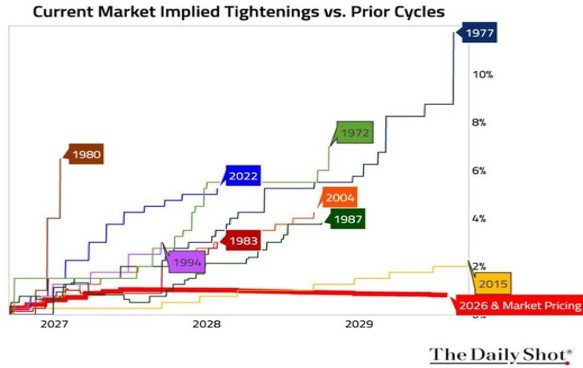
The Investment Team believes an extended series of rate hikes would push the U.S. economy into a tailspin. While several rate hikes would ease inflationary pressures, it is something the government can ill afford. With the current budget deficit exceeding two trillion dollars a year, an economic slowdown would depress tax receipts, while the need for social spending would soar. One of the driving forces behind this year's uptick in inflation has been higher energy prices. Higher interest rates are unlikely to help on that front unless the Fed embarks on a traditional rate-hiking cycle, which would disrupt the economy to the extent that a weaker economy would lead to the destruction of fossil energy demand.
In short, there is only so much the Fed can do to lower inflation, which is the key determinant of long-term bond yields. Earlier in the quarter, U.S. Treasury Secretary Scott Bessent expanded the U.S. Treasury's bond buyback program to $6 billion per operation, triple its original size, in an effort to curb rising yields. Merely a U.S Treasury version of the Fed’s Operation Twist which was in effect in 2011 and 2012, we consider their action akin to eyewash and believe they will not have a material impact on rates. It is our belief that the current administration will likely push for broad-scale adoption of stablecoins, potentially creating a natural buyer for Treasury Bills, if circulation of stablecoins broadens.
Until the U.S. government exercises financial discipline, inflation is likely to remain above the Fed's 2% target, with interest rates maintaining an upward bias. Neither political party appears to care about fiscal austerity. The markets will force the politicians to act. In 1993, James Carville famously remarked: “I used to think if there was reincarnation, I wanted to come back as the president or the pope or a .400 baseball hitter. But now I want to come back to the bond market. You can intimidate everybody.” This may ring true sooner rather than later.
As the year enters the homestretch of 2026, U.S. midterm elections will likely move to center stage as November 3rd approaches. Quarterly earnings release season kicks off in a few short weeks. With the economy appearing to remain on track, expectations are that earnings will likely be good, but with heightened valuations, the key question becomes whether they will be good enough.
MAP’s investment process emphasizes the controllable: buying quality businesses at attractive valuations, maintaining a margin of safety, and remaining patient when market sentiment diverges from fundamentals. This approach has enabled our equity portfolios to participate meaningfully in favorable markets while providing an important measure of resilience when conditions become challenging.
The Investment Team continues to find opportunities across the global markets where the gap between a company’s underlying value and market price remains compelling. As always, we remain selective and disciplined, allowing valuation and fundamentals – not short-term market sentiment - to guide investment decisions.
Thank you for your continued confidence and partnership. Our commitment remains to deliver the best possible risk-adjusted returns in a continually changing environment.
Managed Asset Portfolios Investment Team
Michael Dzialo, Karen Culver, Peter Swan, Zachary Fellows, and Nicolas Vilotti
October 2026
1 FactSet
2 https://bfi.uchicago.edu/insight/research-summary/railroads-reallocation-and-the-rise-of-american-manufacturing/
Certain statements made by us may be forward-looking statements and projections which describe our strategies, goals, outlook, expectations, or projections. These statements are only predictions and involve known and unknown risks, uncertainties, and other factors that may cause actual results to differ materially from those expressed or implied by such forward-looking statements. The information contained herein represents our views as of the aforementioned date and does not represent a recommendation by us to buy or sell this security or any other financial instrument associated with it. Managed Asset Portfolios, our clients and our employees may buy, sell, or hold any or all of the securities mentioned. We are not obligated to provide an update if any of the figures or views presented change.

